Merry: we’ve been conducting an ongoing study to see what Legolas will and will not eat
Pippin: grass? yes!
Merry: moss? yes!!
Pippin: leaves? Ohh, yes!
Merry: bootlaces? Strange but true!
Pippin: worms? Sometimes!
Merry: Rocks? Nah
Pippin: twigs? usually!
Merry: Pippin’s cooking? Inconclusive!
Faramir: how did you… test this
Merry: you just hand him stuff and say ‘this is for you’ and if he eats it, he eats it
Faramir: …….I don’t know how to feel about this
Aragorn: IS THAT WHERE ALL MY SPARE BOOTLACES WENT
Pippin: well what did you need so many spare bootlaces for anyway
Aragorn: in case… the ones in my boots…. break!!!
Pippin: !!!!!ohhh!!!
Merry: aha!
Faramir: how could you not know that
Pippin: pff you expect me to know how boots work? *walks away*
Legolas: when I ate them, I did not know they were your bootlaces. I thought they were leathery and inferior worms.
Aragorn: so you didn’t even enjoy them
Aragorn: why did you eat them ALL if you didn’t enjoy them
Legolas: Merry and Pippin seemed to like it when I ate the gifts they gave me so usually I ate them
Merry: *slamming his fist down upon the table* you’ve COMPROMISED our test results!!
Gimli, from a distance:
Merry, yelling back: WHAT WOULD YOU KNOW ABOUT IT ARE YOU A SCIENTIST
Gimli: YES
This is UNFAIR because obviously Merry and Pippin are conducting a Single-Subject research design which is commonly used in fields like psychology where the subject works as its own control. They aren’t testing all elves willingness to eat twigs, they’re testing Legolas’ willingness to eat twigs.
By outing their testing in what is obviously the intervention stage and not allowing for a natural return to the reversal stage, Aragon has possibly ruined months of data.
In conclusion, Gimli is acting like a second year hard-science major who just took their first statistics course and both he and Aragorn should feel bad
Hell yeah! Tell em my social science sibling! Also it’s clearly a qualitative – observational case study!
I appreciate everyone defending them but Merry and Pippin DEFINITELY ruined their own results by laughing every time Legolas ate one of their ‘gifts’
Did they though? Technically their research question was just “will he eat it” not “does he eat it normally/unprompted”. The fact that he choose to eat it because they had conditioned him to eat things they handed to him doesn’t invalidate the premise, since he did still eat the Thing
That’s fair. I stand corrected, they were doing fine.
possibly their experiment was “can we condition legolas to eat anything we hand him”
here’s a handy checklist for anyone considering redeeming a villain!!!
are they…
❏ a wife beater? ❏ sexually abusive? ❏ violent towards small children? ❏ extremely racist? ❏ a goddamn fascist?
if you checked any of these boxes, not only should you not redeem that villain, but I’m also going to come to your house and pour sewer water into your sock drawer for even considering it
this is really stupid. fiction isn’t a real life scenario, it’s an environment where we can do what we can’t irl. That includes hoping for evil people to do better, and believing they can. it can be HEALING to be an abused kid and watch abusers similar to your own recognise their wrongs and WORK to change. just because it’s not for you doesn’t mean someone else can’t enjoy it or find solace in the redemption of a proxy when the real abuser they love will never do the same. not to mention that abusers can and do see redemption arcs as a reason that it is WORTHWHILE to try and change. which is yknow, a good thing.
a lot of people in the notes are talking about endeavour. I hate that bitch too. every single part of him doing better makes me anxious because I don’t believe he’s changed. however, his arc and family dynamic currently is being played very well, and he’s not just suddenly perfect and loved. he’s WORKING for it and it’s not an all at once deal. that’s how such a thing should be.
I know it’s stressful when an abuser actually tries to change (though are you really going to argue that even in reality they shouldnt try to?). but fictional redemptions aren’t about actuality they’re about wish fulfilment. you may hate redemption arcs but you don’t get to level moral superiority or righteousness over people that want or need the kind of fantasy that they fulfill. just don’t consume the media instead of trying to police what other people write.
Spreading this anti-redemption narrative is dangerous. There are actually reformed abusers in real life. Does this erase or excuse what they’ve done in the past? No. Does this mean their victims have to interact with them? No. But they can change, and some of them are trying to do good. We need to encourage that. We gain nothing by telling abusers to keep abusing.
All I can gather from OP is that WE SHOULDN’T BELIEVE OR TELL PEOPLE THAT IT’S POSSIBLE TO CHANGE and. ??? That’s. Destructive as hell. Discouraging everyone who’s actually trying to do better, because those people exist. And it’s also not true.
(Nobody is arguing that anybody who was victimised by someone like that has to forgive or ever talk to them again. But saying “you’re horrible if you think (or hope/wish, because a lot of those fics are about wish fulfilment, often by victims) that even people who did very terrible things can understand they did wrong” is just garbage.)
That’s it, everyone who likes Autobot Megatron. Cease enjoying reading about a thing RIGHT NOW. The Internet fan police demand it!
OP tell me when you’ve put sewer water in George Lucas’s sock drawer for redeeming Darth Vader in 1983, I want to follow the inevitable court case.
Also, read up a little bit on what restorative justice after a genocide looks like. It’s actually pretty important in the real world right now. And spoiler: it doesn’t just look like a string of additional genocides, even when half the population of someplace was recruited by a fascist regime!
#op needs a redemption arc
Oh wow, family time flashbacks.
It’s not just Puritanism with a gay hat, now we can name denominations!
Calvinism. Y’all it’s Calvinism.
You’re doing double predestination. It’s the theological doctrine that says God has chosen some people to be saved and some people to be damned. That some people are just born evil and cannot be saved/changed.
It’s very popular here, it seems.
It’s fucking bullshit. People can change, they are not inherently evil, but they have to want to change, and you telling them that not only can they not, but that they are doomed no matter what, you might as well step down from on high and say you’ve damned them to eternity as the new son of god because that’s the kind of arrogant assholery you’re preaching, you miserable rod of rusted iron.
You do not have to forgive anyone who has hurt you or hurt others, but you do not get to say they are worthless and unworthy of bettering themselves. You do not get to dehumanize them.
yknow the more jk rowlings world falls apart in america (race relations, international history, population, etc) the more i like to think that america just straight up doesnt have the statute of secrecy. european countries are falling over themselves hiding magic but come to georgia and theres a drunk redneck wizard wingardium leviosa-ing the shit out of a tractor to the delight of his drunk redneck muggle buddies in a walmart parking lot.
wizard on muggle violence is prevented by virtue of there being like a 50/50 chance that muggle is packing heat. muggle on wizard violence is prevented by knowing that wizard can give you boils spelling LIL BITCH on your forehead if you try to start something.
america is the weird redheaded stepchild of the magic world.
im not gonna stop reblogging this until this is the next Hot Fanon
english muggles come back to england and suspicious wizards meet them at the airport.
‘did you witness any strange or inexplicable acts while you were in america?’ they demand.
the english muggles just laugh in their dumb fucking faces. mate, it’s america.
what’s the difference between a werewolf and an animagus?
english wizard: *two hour lecture on legal history*
american wizard: six beers
@jumpingjacktrash congrats ive read hundreds of comments on this dumpster fire of a headcanon and yours is the best
thank you my patronus is a monster truck
I have reblogged this I don’t even fucking know how many times but I still completely lose it every time I see the words “My Patronus is a monster truck” because that is the most AMERICAN thing I’ve ever seen in 29 years of being ‘merican.
Variant: What with the International Statute of Secrecy being an international law, the American magical community suffered quite a bit at the hands of forcible attempts to make everyone conform to it, until anti-seclusionist magical forces got their hands on the sort of magics being used to hide the wizarding world from nonmagical society, and hid themselves and their communities from the magical government and its institutions.
That’s why Ilvermorny is “the only American wizarding school.” That’s why the American magical population feels like something the size of the British one pasted on something a couple orders of magnitude bigger. That’s why Fantastic Beasts And Where To Find Them is so white. That’s why nonmagical people have a persistent quiet willingness to believe in magic just enough to allow for the possibility of its existence, and fill their stories with it, and readily interact with the idea of it. It’s an elaborate homegrown smokescreen to hide hundreds of integrated magical communities from the magical community that demands magical communities keep themselves secret.
The forces behind the International Statute of Secrecy made themselves such an absolute nuisance that some 95% of the magical population of America stole their hide-from-the-muggles spells and locked them out of knowledge of their existence.
The International Wizarding Community: “You are now forbidden to let any nonmagical people know you exist.”
Six Gazillion American Wizarding Communities: *Jedi mind trick hand motions* “Fuck you, we don’t exist. Nothing to see here.”
The International Wizarding Community: “Looks like the problem’s been solved, I guess. Pip pip cheerio.”
Six Gazillion American Wizarding Communities And Their Muggle Friends: “OK I’mma cast Engorgio on my tires and invent Monster Trucking, hold my beer.”
hey I don’t think I’ve ever talked here about corn wolves. here let me find a gas station real quick
okay so I’m in the middle of nowhere stopped for gas in a small town in Iowa rn and my Internet is REALLY spotty so I hope this posts but
as people who have followed this blog for longer might know, sometimes I go hang out with this corn genetics lab at school, as in we meet up on friday nights to talk about corn science and stuff. once the corn genetics subject of the week is covered sometimes we go off track and start talking about other stuff. as u may imagine from a corn genetics lab, most of the members grew up on farms here in the midwest, and one night we were talking and a couple of the people started discussing an urban legend that they were taught as kids to keep them from running into their family’s cornfields and getting lost. one of those people was from Nebraska, and the other from rural minnisoda- these were isolated incidents of this urban legend happening, and all of us were deeply engrossed in this. i cannot make this shit up, this is the story:
there are wolves that live inside the corn when it’s full grown. they’re huge, and are camouflaged to hide in the fields. their breathing sounds like the misting of the irrigation systems set up over the corn in these areas for water. if they see small children in the fields, they kill and eat them.
now I’ve lived my whole life in suburban Iowa, and I can vouch that we don’t have irrigation systems like that here; our group came to the conclusion that this must be the reason that from our 7 or 8 person sample size, the corn wolves did not exist in Iowa, the largest producer of corn. I’ve never seen the corn wolves mentioned anywhere else outside that one night with the genetics lab, and it really fascinates me because as a horror/creepypasta person myself, I think it’s a great example of those strange little urban legends that never get written down on paper. the fact that it’s never appeared anywhere else in my life kind of confounds me, because it’s a really cool story. i like to go driving around rural Iowa when I’m home from college, and i always end up thinking about the corn wolves.
neither of the people believed it as kids btw lol
This is a FANTASTIC piece of Americana and cryptic lore. I propose making them a thing immediately.
Fun geography time.
This isn’t an unprecedented or unusual piece of folklore, and I think
there’s a notable demographic reason that this lore shows-up in the
long-grass prairies of the northern Corn Belt of the U.S. This appears
to be a classic telling of “Roggenwolf” folklore, a variation on the
“feldgeister” concept.
Roggenwolf – or sometimes, Kornwolf – specifically refers to the German folk belief in a phantom wolf spirit which hides in tall corn fields and stalks children. Roggenwolf is one of the more popular and widely-known of the feldgeister spirits.
In German folk culture, Feldgeisters, as is probably obvious from the name, are malevolent spirits which dwell in crops and rural agricultural fields. Feldgeisters
are almost always specifically associated with children; that is, they
are said to target children for torment and death. They are not really
associated with naturally-occurring grasslands or woodlands, but instead
are distinctly related to domesticated crops. Sometimes, some rural
residents will make small ritualistic offerings during harvest season as
a gesture to appease the spirit. The spirit is said to be most active
when crops are at their tallest.
Other variations of the crop-dwelling feldgeister include an evil pig (Roggensau); a dog that tickles children to death (Kiddelhunde); a witch-like corn-woman who kidnaps children (Roggenmuhme); and a chicken that pecks-out children’s eyes (Getreidehahn).
I
would say that there are two (2!) very good reasons why feldgeister lore shows-up in some micro-regions of the Midwest, while being absent
in others. Specifically, both the ethnic heritage and the ecology of a
certain part of the Plains/Midwest create good conditions for
replicating this European lore in North America
People familiar with the cultural
geography of the American Midwest are probably well-aware of the strong
ethnic Norwegian presence among rural agricultural cultures in the
glaciated plains of the Red River Valley of western Minnesota, the
northern half of North Dakota, and northeastern Montana. Ecologically,
this landscape is glaciated prairies with pothole lakes, and often hosts
much more barley than corn. Meanwhile, the Heartland region of rural
Illinois and Indiana, though hosting quite a bit of heavy corn industry,
isn’t too much more ethnically German than other parts of America, and
much of the landscape is a mixture of Rust Belt industrial areas
in-between the cornfields (so it’s not exactly desolate and creepy).
However,
there is very strong ethnic German presence in the long-grass prairies
southern Minnesota, South Dakota, south-central North Dakota, parts of
western Wisconsin, and central Nebraska and Kansas away from the urban
areas of Omaha and Kansas City. In most of this land, over 50% of the
population has German ancestry. Aside from this cultural composition,
this region also lends itself better to creepy, eerie stories because it
is more empty and ecologically homogenous than the rest of the Great
Lakes and Heartlands; this is the region where crops run uninterrupted
for miles and rural dirt-roads run in empty grid networks in every
direction. Though the feldgeister concept has a closer association with
cornfields in Europe, the long-grass prairies (roughly centered neared
Sioux Falls) host 1) heavy German influence, and 2) the most expansive
crops in the country. Therefore, the region is probably ripe for a
replication of spooky German lore about haunted cornfields.
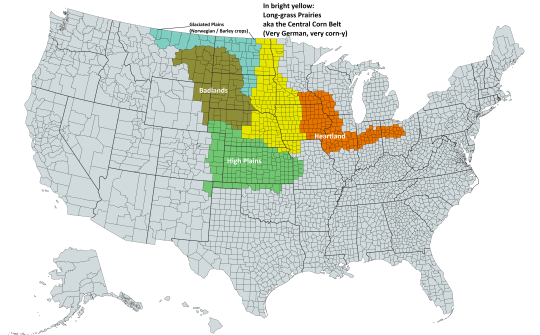
Source: Me Map 1 – Cultural Micro-Regions of the Heartland and Great Plains:
I think that this map might help to visualize where both cornfields and
rural lifestyle predominate, opening the door to rural folklore. The two
regions here where corn agriculture is predominant are the orange and
yellow regions. The orange region, the classic “Heartland”, hosts
Indiana Hoosier culture and the cornfields of Illinois and Ohio.
However, the region is marked by smaller farms and a higher population
density, and is not that rural compared to the plains further west; much
of this region also hosts larger cities and a lot of Rust Belt
industrial zones and dairy farms. The yellow region, however, is both
covered in corn and quite rural, where crops can span from horizon to
horizon. That’s where we would look for German folk culture.
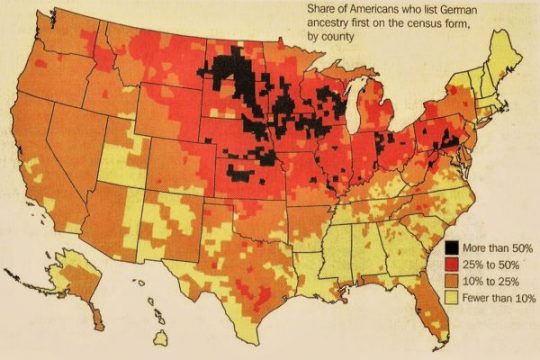
Source: An anonymous hero cartographer who’s had their work stolen by Pinterest users Map 2 – German Ancestry in the U.S.
This might help to visualize the places where predominant corn agriculture overlaps with German ancestry. Note that in much of central Wisconsin and central North Dakota, over 50% of people have German ancestry. But this land isn’t really dominated by corn. However, the region roughly from Fargo (on the Minnesota-North Dakota border) to Kansas City is both heavily German and dominated by corn. —
Anyway, feldgeister lore is scary. I’d love to hear more American versions, since a lot of the scholarship on these spooky corn-wolves is based on folk culture in Germany itself, rather than the diaspora in the U.S.
Saw this post about feldgeister’s going around again, so thought I’d make a low-effort re-post for anyone interested in “Midwestern gothic” or how local ecology influences regional folklore.
this an awesome hot take thank you!!
and just in time for halloween and the corn harvest, too 👀
People who prefer hot weather: Snow and ice are a pain, and the cold is just kind of uncomfortable even when you wrap up, you know?
People who prefer cold weather: MY SKIN LITERALLY MELTS OFF EVERY SUMMER I AM A FUCKING HUMAN SOUP AS WE SPEAK
you wouldn’t believe how many people reblogged this to whine about hot weather in the tags.
too cold? put on another layer!
too hot? change into thinner clothes!
still too cold? put on another layer!
still too hot? uh, get naked I guess?
still too cold? put on another layer!
still too hot? Ţ̡̜̮̗̟̯͘ͅA̛͈͎̤͙̳̦̱̜̺̪K̢̻̥̥̥̪̙̜̩̗̼̤̻̻͖͍̜͈͉͠ͅE̟͕̩͔̪͓͔̥̦͇̣͇̳͕͉͜ͅ ̠̝̥̖̭̦̼́͝O̩̦͓̠͉̲̲̱̪̹̻̼̭̯͎͈̕͢F̷̸̢̛̙͇͔̜̙̮̗̲̤͇̯͡F̧̨̱̤̲̫͕͔̼̭͙̠̙͙̹̻ͅ ҉̫̠͓̙̠͔̕͜͠Y͡҉̴̘̭̬̳́O̶̶̧͚̞̣̯̩̫̜̩͉̤͎͖̖͟ͅU̶̵̺̠̪̘̱̮̮̙̻͈̣̦̭͠͝͞R̨҉̦̺͓̩̺͖̘̪̥̺͚̱͚͔̪͓̖̰ ̷̸̺͇̳͇̖̥̻̳͚̗̥͙̪̣́S̡̞̳͖̭̯͉̻̠͔̥̹̫̣̼̹͇͜K͏̧͍̪̗̖̜̫̙̱̫͈̟̝̮͈̻̺̯̟̠̀Į̧̙͙͔̠͖̟̕͝Ǹ͖͎̳͍̪̱̞͇̺̘̩͘͜͠
The cold is easily shut out, the heat is inescapable hell
THE TRUTH COMES OUT.
Avoidance techniques for the cold:
-more coats, fire, hot food and drink, stay inside, fuzzy sweaters, ear muffs, become a burrito
Okay, so look, @monicawoe was like YOU HAVE TO WATCH this movie, and I was like, I KNOW WHAT THIS IS, I have to vid the thing, and then I grabbed @astolat and was like YOU HAVE TO HELP ME VID THE THING, because we have a relationship where we do things like that, and so here it is, you’re welcome!
I’m dying, nothing could make me want to watch this movie so much as the implication that it’s basically just the weird superhero genre revamp of Mary Tyler Moore
hey asking for a friend but uh. what’s it gonna take for fandom to relearn the difference between “canon” and “word of god”?
★ canon = the text itself; the show/movie/book/comic; the actual up-on-Netflix content; anything a casual fan would reasonably interact with ★ word of god = anything else, i.e. interviews with cast/crew/showrunners; DVD commentaries; comments from the crew on social media or at cons; literally any written or verbal remarks about the text made by writers or showrunners or actors
word of god does not equal canon, and yet i increasingly see fandoms conflating the two and acting like word of god comments from The Powers That Be count as canon and are equivalent to canon footnotes to the text and i’m. NO. listen. it’s not. that’s not what canon means, and word of god comments should not be treated as part of the canon text. this isn’t just me being a pedantic text purist, this has actual negative consequences for shows and fandoms and people’s experience of the stories, i mean:
it privileges the creator’s interpretation of the text as the only “correct” one. death of the author? no one’s heard of her. writers and showrunners get to tell fans how to interpret the text, and a solid 80% of fandom is going “okay, if you say so!”
it stifles fandom debate and analysis, because fan analysis of the text at hand is rejected outright by other fans on the basis that “well the showrunners said it’s like this”
it contributes to fandom bullying, in which word of god comments are used to harass people who have the audacity to want to interpret the work differently, or who disagree with the powers that be, or just don’t want to consider those comments at all in their understanding of the story
word of god comments may be confusing; they may change over time or contradict earlier statements; they may even contradict the text itself. all of which leads to fans frantically trying to reconcile word of god comments with actual canon, rather than going “okay fuck this, it doesn’t make sense so i’m disregarding it”
again: this only creates more arguments in fandom; if creators say x at one point, and y at another, you end up with more fandom slap-fights over which comment was the ‘correct’ one and which interpretation ‘wins’
it encourages lazy and unsatisfying storytelling. if fanon will accept word of god comments as canon, showrunners develop an attitude of “it doesn’t matter if it doesn’t make sense, we can just handwave it in an interview”
this results in poor writing, or important plot points being explained in word of god comments rather than in actual canon
this in turn makes the story confusing and incomprehensible to anyone who’s not knee-deep in fandom. casual fans, kids, someone bingeing the series 5 years from now on crunchyroll… they’re not reading the interviews or tweets or watching the comicon panels. those viewers still need to be able to understand the story, and we are slip-sliding towards a creator-fandom model in which they won’t be able to, because word of god comments run the risk of becoming required reading for understanding the story
this has serious implications for how stories handle representation: if fans start accepting word of god as equivalent to canon, it means shows can keep canon rep (particularly queer rep) vague and ambiguous, and prop it up with word of god comments that “confirm the representation”. there’s no incentive to actually commit to unambiguous, clear canon rep if stories can lean on word of god to compensate for the utter lack of actual diversity in the canon text itself
the canon text has to stand alone. word of god should serve as a trove of fun trivia or behind-the-scenes tidbits about the writing process; it is not supposed to be a substitute for clear, concise, and comprehensive storytelling. a story that doesn’t make sense unless you’ve read 8 different explanatory interviews by the writers is badly written. showrunners who treat interviews as a place to offload all the character development or plot explanations they didn’t bother to include in the actual text are lazy hacks who are bad at their jobs.
word of god can be handy and fun and informative, and for people who are interested in creator comments or interviews there’s no harm in paying attention to that stuff. but it’s not canon. the canon is the text itself. anything else is supplementary to that, and fans are absolutely allowed to disregard anything not in canon if they choose.



 missionlameturtle