ngl but I’m getting alittle annoyed with the way people keep pushing Dreamwidth.
Yes, Dreamwidth is run by fandom-friendly folks. But it is also firmly stuck in the bad old world of online fandom that was divided between the small number of talented content creators and the masses of mostly non-participating lurkers. Dreamwidth may be great for creators, but for the rest of us who participate in fandom through reblogs or retweets – the active curation of ours and others’ fandom experience through our Tumblrs or Twitter accounts – a return to a 2000s-style fandom experience means a return to a world where most of us are relegated to a passive audience.
I know the most of people pushing Dreamwidth so hard don’t mean it this way, but the way some of them are so, so blasé
about the lack of a resharing function is kinda starting to feel like some of them want us to sacrifice our participation in fandom in order to preserve their fandom experience.
I like tumblr because it feels like a conversation where everyone is invited to join if they want to. I definitely don’t care about writing meta on ao3, for instance – I don’t want meta to be the nonfiction equivalent of fanfic, where one person writes and readers read and give kudos and maybe comment. I want it to be a conversation. I think that’s why my attempts at writing fanfiction always fail while meta generally comes more easily – it does not feel like an individual activity where I share the finished product (and I can’t muster enough motivation to finish it). It feels like a prompt for a conversation, even if the meta ends up being like a mini essay. I like how things just bounce from blog to blog. It feels alive and it keeps me motivated to be active. I don’t feel like the Meta Writer who dispenses their Thoughts to others while others nod and clap and occasionally write a letter back to give me their feedback, you know? It feels like everyone’s sitting around the fire and sure, someone talks more and others tend to listen, but it still feels like we’re having a conversation together.
I’ve had a dreamwidth for years… I think longer than I’ve had a tumblr… but I don’t use it, and I don’t like it. But then again, I never liked LJ either, so that explains a lot of it.
The only reason I’m currently stuffing meta onto AO3 is because it’s a stable platform that can handle the load. It’s just a convenient lockbox to secure stuff I’ve written for the time being until I can find a better home for it and have the time to sort through it all. If this site flushes itself down the internet tubes, I just want to make sure I’ve salvaged everything I can before it all disappears forever.
So I might have a dreamwidth, but it’s more of a placeholder hoping something better and more long-term viable for me personally pops up. It’s just so… clunky compared to how fluid tumblr’s dash is.
And Pillowfort tries to be Tumblr Plus LiveJournal, which I guess is fine, but the inability to add to reblogs bugs me. Half of what I find entertaining about sharing on Tumblr is seeing that trail of commentary after someone’s random thought. And a comments section doesn’t have the same flavor of community creation.
To me comments are just for the OP. Reblog commentary is for the community.
I was in a tiny fandom on LJ back in the day, and for the public posts in the community forum, threaded comments were definitely for everyone. The difference is, it had a specific and obvious audience – the other fandom people in the comm. (This was a tiny fandom, so there was only one comm. But in a larger fandom, this would not be public to everyone in the whole fandom, only the people on that particular fandom space…).
Someone would post a question or a headcanon and everyone would discuss and it was 100% not about the OP – it was just all of us having a good conversation.
Not like commenting on private LJ blogs.
That kind of community discussion was a bit different though, because if you replied, your audience *included OP*. So you couldn’t add a super snarky commentary that’s addressed to YOUR user base and not to OP. Like people do on twitter a lot.
If you disagreed you had to debate in a way that included OP, and thus probably be… politer?
I think that style of community discussion tends to create more positive spaces, because no one feels like they are talking behind the last reblogger’s back and can therefore be snarky to them.
Like right now, I’m reblogging this from @ltleflrt and I feel a little uneasy in case they take offence at my disagreement. Tagging someone you’re not a mutual with can feel a bit scay because what if they think you’re being a dick? (hi @ltleflrt, sorry for picking on you – I’m not trying to be a dick, I’m wingstocarryon and I’ve followed you for ages and I like you, sorry!).
But the reblog function means I’m not talking to @litleflrt directly. I mean, I COULD tag you and have a conversation WITH you, directed at you, but the medium makes me feel like I’m reblogging to MY followers. It only changes if we’re mutuals and I know you’ll read what I’m writing. Then it becomes more friendly, less passive-aggressive. Even when I don’t WANT to be passive-aggressive, I just want to add my thoughts to the pile.
Like, I enjoy the spark that happens with the disagreement and the snark and all the takes piling on. But it’s a different feeling of what the community is. People with different interpretations are more likely to come into conflict, I think.
I’m not saying this to dispute anything above, though. Just thinking aloud.
I LOVE the posts that are made by reblogs. There’s a kind of creativity that comes from being able to add stuff and make it all public. I’d miss that a lot.
Idk. I didn’t realize you couldn’t add commentary to PF reblogs. That’s too bad.
It would be interesting to see what style ends up taking over in a system that allowed both.
I started using LJ in 2001 and never got into communities even tho I used the site regularly to blog for years. I never made friends on that site, maybe had 5 followers and 4 were irl friends. And communities were SO clique-ish. At least the ones I poked my head in were. It was never the right environment to pull me into socializing.
Tumblr, on the other hand, sucked me right in. People who followed me could share my posts and expose me to their groups, and suddenly my conversations spread to new people who weren’t part of my circle. This was before you could @ someone, and you just looked at your post notes to see who added commentary to their reblog (which is how I saw your reply @fandom-after I never got notified of you tagging me. Also hi! No offense taken because it’s just a conversion! lol) and as the op I could either reblog to talk back or just ignore whatever was added.
The op is still involved in reblog conversations with everyone who interacts with the post. And that fear of tagging someone you don’t usually interact with seems no different than being too shy to comment in a community. So I’m still not seeing the benefit of communities driven by comment conversations in LJ/Dreamwidth/Pillowfort vs reblog conversations on Tumblr.
But there’s a reason Pillowfort exists. The smaller community vibe was missed by old LJ users enough to try and hybridize the two social media styles. I’m just not one of those people 🙂
If one remembers this particular episode from the popular sitcom ‘Friends’ where Ross is trying to carry a sofa to his apartment, it seems that moving a sofa up the stairs is ridiculously hard.
But life shouldn’t be that hard now should it?
The mathematician Leo Moser posed in 1966 the following curious mathematical problem: what
is the shape of largest area in the plane that can be moved around a
right-angled corner in a two-dimensional hallway of width 1? This question became known as the moving sofa problem, and is still unsolved fifty years after it was first asked.
The most common shape to move around a tight right angled corner is a square.
And another common shape that would satisfy this criterion is a semi-circle.
But
what is the largest area that can be moved around?
Well, it has been
conjectured that the shape with the largest area that one can move around a corner is known as “Gerver’s
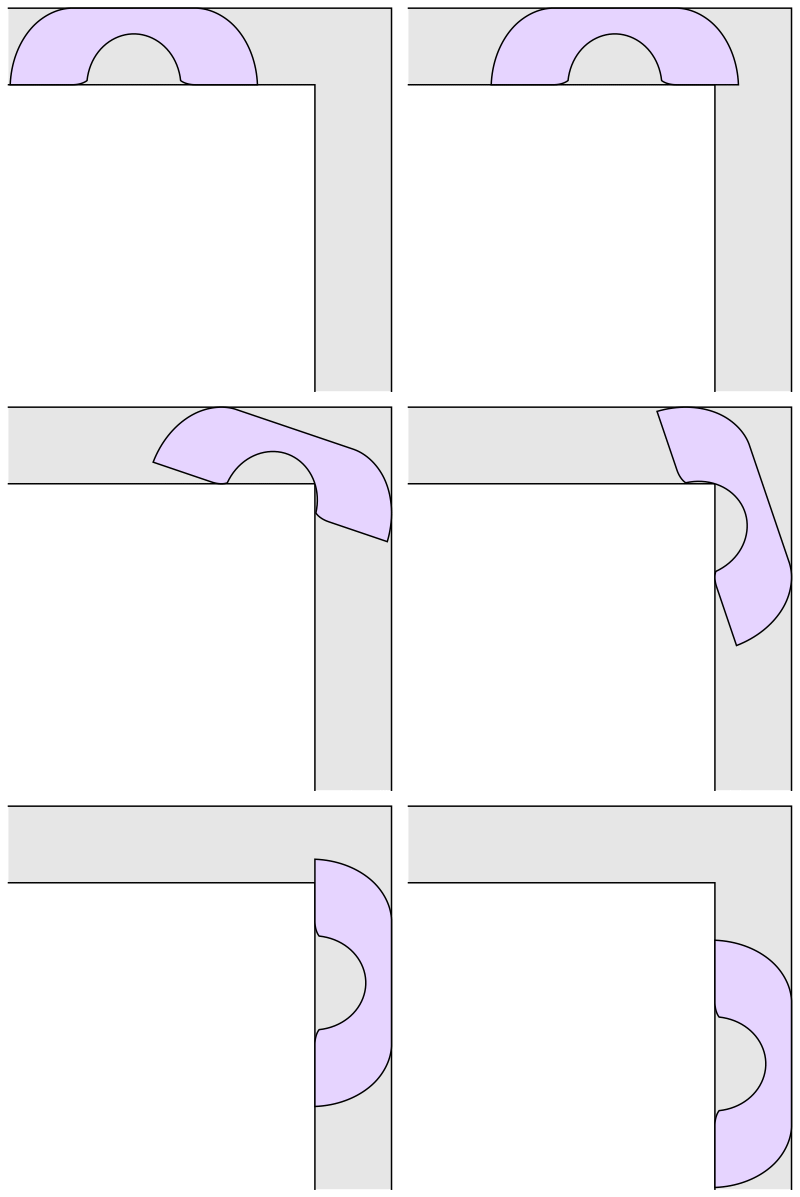
sofa”. And it looks like so:
Wait.. Hang on a second
This
sofa would only be effective for right handed turns. One can clearly
see that if we have to turn left somewhere we would be kind of in a tough
spot.
Prof.Romik from the University of California, Davis has
proposed this shape popularly know as Romik’s ambidextrous sofa that
solves this problem.
Although Prof.Romik’s sofa may/may not be the not the optimal solution, it is definitely is a breakthrough since this can pave the way for more complex ideas in mathematical analysis and more importantly sofa design.
Have a good one!
I don’t know what to do with this information but I support it
its not really “ace discourse” you just. don’t like ace people and are trying to “discourse” them all into identifying as something else
It’s not ace discourse, exclusionists are just bigots. Discourse is a discussion, and there isn’t a discussion to be had here. Exclusionists are assholes, and they’re WRONG. End of story. It’s not discourse, it’s bullshit.
this! like. we dont call homophobia “gay discourse” we shouldnt call aphobia “ace discourse”
Man it’s weird, reflecting on the Stargate franchise’s 17-season multi-movie television juggernaut now, in the context of the 90′s, the 2000′s, 9/11, military imperialism, and cultural shifts through the years.
Like, the original SG-1, at least up until season 8 or so, is in retrospect so obviously a Cold War narrative. The main thematic conflict the whole series is founded on is the idea of negotiation vs violence: when can we talk it out and when do we shoot? How can we keep our people safe in the face of overwhelming danger, when we know, the stronger we get and the harder we fight, the more we might provoke the enemy? What is it even ethical for us to do with and to and for another culture? There are fair-weather allies that become enemies that become allies again, there’s the literal Goa’uld scare of they could be anyone, and how would we even know?, and our biggest Earthside antagonists are either a shadowy three-letter government spy agency, or Russia. Cold War. It gets more complicated as seasons go on, as your biggest Goa’uld threat turns out to be Ba’al who looks like a legitimate businessman right here on Earth, as the Lucien Alliance starts putting itself together like the Russian Mafia in the aftermath of the fall of the USSR.
SGA on the other hand is 100% about the Iraq War/Afghanistan, starting when our intrepid band of protagonists roves off to another galaxy in search of power sources and weaponry they can claim for their very own. The entire Daniel Jackson ‘let’s talk it out!’ goes out the window–Wraith don’t negotiate, period, ever, and also nobody on our gate team particularly cares to try. Instead, our whole main thematic conflict is, how do we deal with the legacy of our forebearers’ mistakes, and also our own, which is absolutely a cornerstone question of the whole Iraq conflict. Every single recurring enemy in SGA was either created or made much, much worse specifically because of something our protagonists do, from Michael to the Asurans all the way back to waking the Wraith up in the first place. Most of the problems around the Pegasus galaxy were caused by the Ancients, who the natives call ‘the Ancestors’ and various members of the Atlantis team can literally claim as their own ancestors, screwing around and interfering and making a mess and then fucking off to let everybody else deal with it. I could probably write an entire essay. There is a massive essay to write.
And, right, in both of these shows, the military are the good guys!!! In SG-1, they need to be tempered by Daniel and his ‘hey maybe don’t shoot the first people we meet on a new planet’, but fighting the Goa’uld is good and right and even if we’re not going to kill them all, it’s better if we prove we can kill them all, just in case. There’s a lot of the warm-fuzzies of ‘we’re taking down genocidal Cold War dictator-proxies!’, which is very nice. There’s a whole lot less of ‘and then, the Vietnam War.’ There’s definitely reference to how the planets our heroes pick to draw their line in the sand often suffer for it far worse than Earth does, but it all kind of gets glossed over–it’s fine, bad things happen but it’s fine, it’s just the price of freedom. Which makes a lot of sense in a post-Cold War context, when the show is drawing from decades of tension and conflict that are over now. In 1996 and 1997, when the Cold War was over but everybody still remembered it, and good sci-fi about the threat of planetary nuclear annihilation or possibly getting taken over by aliens/communism was really appealing in a ‘and the good guys win!’ way. So we can pick the parts that make for good TV and admirable heroes, rewrite the history so it’s not as scary, and tweak it a little more to make the good guys always good.
SGA actually does a lot less skimming over of ‘hey here are all the reasons our protags are actually pretty awful!’ They’re explicitly responsible for pretty much every bad thing in the Pegasus Galaxy, and it comes up and gets talked about. Which makes a ton of sense in the context of 2004-2009 when the show aired, as the Middle East kept exploding and almost settling out and then exploding again, and probably it was all the US’s fault in the first place–the idea of a military that fucked up and created their own worst enemies was very much in the public consciousness. Which makes it even more interesting that SGA somehow managed to keep the military, and their various civilian and occasionally native allies, as the good guys. The ethic of the show seemed to be, ‘okay we fucked up, and every time we try to fix it we usually fuck something else up even worse, but at least we keep trying.’ The last guys who screwed Pegasus up said ‘the hell with it’ and took off, leaving Wraith and ruins and all sorts of gene-locked booby traps behind them, so our protags get all the credit for trying to stick it out even though they’re fundamentally operating on a really sketchy foundation of imperialism and would-be genocide.
It’s just really interesting watching these shows now. The early seasons of SG-1 feel so culturally distant, from the way they try so hard at feminism (and they are very sincere in trying very hard!) to the way the whole show is simultaneously so pro-military, and unabashedly, joyfully pro-science and discovery. Early 2000′s SG-1 goes out of its way not to even admit anything’s going on in the middle east at all, which is part of why it’s such a departure when John Sheppard shows up straight out of Afghanistan. Comparing Jack O’Neill and John Sheppard, and what rank and duty and obedience and insubordination mean to each of them in the context of the very different wars they each fought before they ended up among the stars, is super illustrative and super interesting. Comparing any of it to the world of 2018 is interesting, too, because I don’t know what a Stargate franchise would have to look like today. What war are we fighting any more? What war could we feel good about fighting? You don’t see a ton of sci-fi these days when the good guys are the government.
rather than death of the author i subscribe to a critical framework i like to refer to as Schrodinger’s Author where the authors intentions are important except for when i dont like them








 missionlameturtle