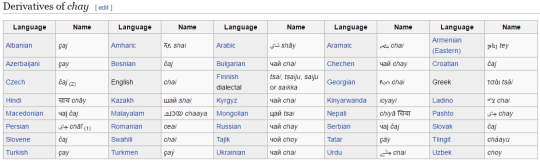
is “chai” a TYPE of tea??! bc in Hindi/Urdu, the word chai just means tea
its like spicy cinnamon tea instead of bland gross black tea
I think the chai that me and all other Muslims that I know drink is just black tea
i mean i always thought chai was just another word for tea?? in russian chai is tea
why don’t white people just say tea
do they mean it’s that spicy cinnamon tea
why don’t they just call it “spicy cinnamon tea”
the spicy cinnamon one is actually masala chai specifically so like
there’s literally no reason to just say chai or chai
They don’t know better. To them “chai tea” IS that specific kind of like, creamy cinnamony tea. They think “chai” is an adjective describing “tea”.
What English sometimes does when it encounters words in other languages that it already has a word for is to use that word to refer to a specific type of that thing. It’s like distinguishing between what English speakers consider the prototype of the word in English from what we consider non-prototypical.
(Sidenote: prototype theory means that people think of the most prototypical instances of a thing before they think of weirder types. For example: list four kinds of birds to yourself right now. You probably started with local songbirds, which for me is robins, blue birds, cardinals, starlings. If I had you list three more, you might say pigeons or eagles or falcons. It would probably take you a while to get to penguins and emus and ducks, even though those are all birds too. A duck or a penguin, however, is not a prototypical bird.)
“Chai” means tea in Hindi-Urdu, but “chai tea” in English means “tea prepared like masala chai” because it’s useful to have a word to distinguish “the kind of tea we make here” from “the kind of tea they make somewhere else”.
“Naan” may mean bread, but “naan bread” means specifically “bread prepared like this” because it’s useful to have a word to distinguish between “bread made how we make it” and “bread how other people make it”.
We also sometimes say “liege lord” when talking about feudal homage, even though “liege” is just “lord” in French, or “flower blossom” to describe the part of the flower that opens, even though when “flower” was borrowed from French it meant the same thing as blossom.
We also do this with place names: “brea” means tar in Spanish, but when we came across a place where Spanish-speakers were like “there’s tar here”, we took that and said “Okay, here’s the La Brea tar pits”.
Or “Sahara”. Sahara already meant “giant desert,” but we call it the Sahara desert to distinguish it from other giant deserts, like the Gobi desert (Gobi also means desert btw).
Languages tend to use a lot of repetition to make sure that things are clear. English says “John walks”, and the -s on walks means “one person is doing this” even though we know “John” is one person. Spanish puts tense markers on every instance of a verb in a sentence, even when it’s abundantly clear that they all have the same tense (”ayer [yo] caminé por el parque y jugué tenis” even though “ayer” means yesterday and “yo” means I and the -é means “I in the past”). English apparently also likes to use semantic repetition, so that people know that “chai” is a type of tea and “naan” is a type of bread and “Sahara” is a desert. (I could also totally see someone labeling something, for instance, pan dulce sweetbread, even though “pan dulce” means “sweet bread”.)
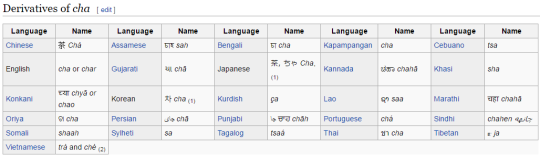
Also, specifically with the chai/tea thing, many languages either use the Malay root and end up with a word that sounds like “tea” (like té in Spanish), or they use the Mandarin root and end up with a word that sounds like “chai” (like cha in Portuguese).
So, can we all stop making fun of this now?
Okay and I’m totally going to jump in here about tea because it’s cool. Ever wonder why some languages call tea “chai” or “cha” and others call it “tea” or “the”?
It literally all depends on which parts of China (or, more specifically, what Chinese) those cultures got their tea from, and who in turn they sold their tea to.
The Portuguese imported tea from the Southern provinces through Macau, so they called tea “cha” because in Cantonese it’s “cha”. The Dutch got tea from Fujian, where Min Chinese was more heavily spoken so it’s “thee” coming from “te”. And because the Dutch sold tea to so much of Europe, that proliferated the “te” pronunciation to France (”the”), English (”tea”) etc, even though the vast majority of Chinese people speak dialects that pronounce it “cha” (by which I mean Mandarin and Cantonese which accounts for a lot of the people who speak Chinese even though they aren’t the only dialects).
And “chai”/”chay” comes from the Persian pronunciation who got it from the Northern Chinese who then brought it all over Central Asia and became chai.
I really have two RayV ships that I read, so I guess I’ll do both? Here we go!
RayV/Stella
who’s the cuddler: Ray. Unquestionably.
who makes the bed: Honestly, I can’t really imagine either of these characters spending a lot of time making the bed. Whoever gets up last makes it, but Stella’s the one who really emphasizes that it needs to be made every day?
who wakes up first: Usually Stella, but sometimes she’s up late working on a case and Ray gets up first, makes coffee, and puts a mug of it for her on the nightstand for when she gets up (it’s a nice gesture but she usually ends up pouring it out and making a new pot anyway; room temperature coffee is almost as bad as microwaved coffee, and Stella didn’t fight and bargain and struggle through all those years of law school to still be drinking mediocre coffee). On lazy days off Stella usually wakes up first but will lounge in bed reading until Ray brings her her coffee and maybe some morning sex.
who has the weird taste in music: Look, only one of these people was married to Ray Kowalski, punk cop extraordinaire. Having a tolerance for trying out lots of different kinds of music was a survival skill.
who is more protective: Ray, definitely, on an everyday level. Honestly, neither of them is all that protective of the other in any sort of overbearing sense–they trust each other’s abilities too much for that–but Ray hates the way criminals she’s put away will sometimes send Stella threatening letters. The one time Stella gets protective of Ray is when they receive a letter threatening him, and she hunts down the offender and methodically destroys him in court. Ray never thought of himself as someone who wanted a knight in shining armor, but that day Stella does a pretty spectacular job of proving him wrong.
who sings in the shower: RAY VECCHIO, loudly and off key.
who cries during movies: Neither, usually, but occasionally they’ll catch each other sniffling.
who spends the most while out shopping: Oh man, this one’s really a toss-up, isn’t it? They both like nice things, but I think maybe Stella may spend more just because women’s clothes usually cost more?
who kisses more roughly: Stella, absolutely. Ray’s pretty thrilled about it, to be perfectly honest.
my rating of the ship from 1-10: It’s a pretty solid 6.5-7. I really like these two together in concept, but I don’t feel like show gave them much of a chance.
NUMBER TWO: RayV/RayK
who’s the cuddler: RayK. Definitely RayK.
who makes the bed: RayV.
who wakes up first: Kowalski’s always up with the break of day, whereas Vecchio is more likely to sleep in. Same trick with the coffee, though, but unlike his ex-wife Kowalski has no problem with reheating cold coffee in the microwave. Vecchio always forgets his smarties, which is a crying shame and also probably deliberate.
who has the weird taste in music: RayK listens to all sorts of things, though he usually circles back around to punk eventually.
who is more protective: RAYK WILL BEAT YOU WITH HIS EMPTY GUN
who sings in the shower: Both of them. They tease each other mercilessly about it, and Fraser can’t understand how two people who fight so much can be so undeniably happy together.
who cries during movies: “Are you crying?” “Shut up, Vecchio, I got something in my eye.”
who spends the most while out shopping: RayV, usually, though sometimes Kowalski splurges on fancy groceries and expensive boots and old records.
who kisses more roughly: It really depends on who’s angrier, most days, but on a normal day when they haven’t been bickering, probably RayK.
my rating of the ship from 1-10: Probably averages out to about a 7 again? This isn’t my OTP by any means, but some fic of it can be stunningly good.
American History: Bernie Sanders is the first Jew to win a presidential primary.
Bernie Sanders would be the 1st non Christian president. That’s an important distinction that is often ignored, actually.
The amount of comments I got on this post saying “JFK was catholic tho” like…. you do understand…. Catholicism is a form of…. you know what nevermind lmao. This is why college should be free. #FeelTheBern
Forever wondering what these people think Catholicism is….
I *never* understood the JFK being catholic as a big deal. Is there somewhere in this country where Catholics are largely persecuted or something and I’m just missing a mega huge chunk of history? Perhaps it’s just because I went to a Catholic school growing up and had one (completely absent but, artificially) Catholic parent, but I can recall seeing nods to that faith *virtually everywhere* as a child on television, in movies, music, etc. And I’m talking specifically catholic ritual and doctrine, not mainline Christian. Like. Catholic Churches. Catholic-specific feast days being on the news. Non-religious affiliate restaurants serving fish during Lent.
I realize Catholicism is not the same as other Christianity and the differences can be pretty big depending on the sect differences, but…it doesn’t really feel like a minority group to me. More like a majority one? Or am I crazy??
Catholicism IS pretty mainstream now, and is privileged in most of the same ways other Christian groups are; and let’s not make the mistake of pretending Catholics were ever persecuted in this country the way Jewish people or Muslims or basically any non-Christian religious group were and in many cases still are.
That said, yes, it was a big deal that a Catholic was elected president. For one thing, Catholicism was associated with “undesirable” immigrants, including Italians, the Irish, certain Eastern Europeans…People like to explain this relationship as them having been regarded as “not white”, but that’s skipping over the complexities of the era to make it easier to explain to a modern audience. It’s more that ethnicity and cultural background mattered far more deeply then than they do now. Think of the term WASP (which dates to the 50s/60s, making its emergence roughly contemporary with JFK) as a taxonomy of privilege as it’s been understood throughout most of American history: if you’re white, you have certain privileges; if you’re also Anglo Saxon, you have advantages; if you’re Protestant on top of that, you’ve got it made. Throughout most of American history it’s been unthinkable for a president to be anything else. For another, the United States was in most part founded by Puritans and has always been strongly influenced by their beliefs, one of which was “Catholics suck”. In fact, one of the defining characteristics of Puritanism was striving to be as not-Catholic as possible. For reasons I don’t want to sidetrack into, one of the ways the American Revolution can be conceptualized is as “English Civil Wars, Part 2″; many of the devoutly Puritan people who viewed the return to monarchy as a step back toward Catholic excess and irresponsibility fled to the colonies following Charles II’s retaking of the throne.
So, backdrop set, let’s talk a little about Al Smith. Winning the Democratic nomination in 1928, he was the first Catholic to really make a serious bid at winning the presidency. (Wiki article on Tammany Hall for some background on Catholic American politics.) And the Republicans ran a successful smear campaign on the basis on Catholicism, Hoover won the election, and the rest is history. Al Smith favored loosening or repealing Prohibition, which was clearly because Catholics, especially the Irish kind, are drunkards, not to be trusted with important decisions. His connections to Tammany Hall brought up lingering fears about Catholic corruption. Urban Catholics such as Smith were a fairly consistent voting bloc for the Democratic party and its more liberal views, which painted Smith as far more radically liberal than he was. The KKK among other institutions ran a slander campaign implying he ran and frequented brothels and making him out to be an illiterate incapable buffoon. And, most importantly for the American Heartland, Catholics have a central figure they answer to, the Pope.
It would be exaggeration to say that the greatest fear of heartland voters was that Smith would essentially be a puppet through which the Pope would take over the country, but it was definitely one of their top five. Though Al made it clear that he strongly believed in separation of church and state, the idea of an unknown foreign Catholic entity who could control him was terrifying for American voters. The concept of the papacy has always been viewed as equal parts horrifying and impenetrably mysterious in the US, and Americans were very aware that the Pope could and did play a heavy political role in the European past. Hoover won comfortably, and the idea of a Catholic ever becoming president seemed more laughable than ever.
Enter JFK, only a generation later. World War II changed things, but old prejudices and fears still linger, especially in the South. The same concerns haunted his campaign, especially the notion that he would be controlled by the Pope, and he losing the South. But JFK had two advantages Al Smith never did: his opponents were far more scrupulous in their mudslinging, and he was able to make a speech on national television that resounded with many Americans. This, combined with changing attitudes on the role of religion in politics and on whether Catholicism was really all that different from other kinds of Christianity, was enough. Today we have trouble understanding why a Catholic being elected would even be controversial at all, and that’s really, in my opinion, thanks to John Kennedy. His speech and subsequent election were a turning point, which is why people such as my father compare Obama to him with such hope in their voices.
(None of this is to say that Catholics were barred from holding power in other ways prior to Kennedy, but the complexities of anti-Catholicism and avenues to power in society in an American context are too many to go into here. I hope that I have demonstrated that anti-Catholicism existed and Kennedy winning was a huge turning point. If you want to discuss other dimensions in which Catholics were or weren’t faced with prejudice in the US, I’d love to–in my inbox or on chat.)





 missionlameturtle