it’s hilarious to me when people call historical fashions that men hated oppressive
like in BuzzFeed’s Women Wear Hoop Skirts For A Day While Being Exaggeratedly Bad At Doing Everything In Them video, one woman comments that she’s being “oppressed by the patriarchy.” if you’ve read anything Victorian man ever said about hoop skirts, you know that’s pretty much the exact opposite of the truth
thing is, hoop skirts evolved as liberating garment for women. before them, to achieve roughly conical skirt fullness, they had to wear many layers of petticoats (some stiffened with horsehair braid or other kinds of cord). the cage crinoline made their outfits instantly lighter and easier to move in
it also enabled skirts to get waaaaay bigger. and, as you see in the late 1860s, 1870s, and mid-late 1880s, to take on even less natural shapes. we jokingly call bustles fake butts, but trust me- nobody saw them that way. it was just skirts doing weird, exciting Skirt Things that women had tons of fun with
men, obviously, loathed the whole affair
(1864)
(1850s. gods, if only crinolines were huge enough to keep men from getting too close)
(no date given, but also, this is 100% impossible)
(also undated, but the ruffles make me think 1850s)
it was also something that women of all social classes- maids and society ladies, enslaved women and free women of color -all wore at one point or another. interesting bit of unexpected equalization there
and when bustles came in, guess what? men hated those, too
(1880s)
(probably also 1880s? the ladies are being compared to beetles and snails. in case that was unclear)
(1870s, I think? the bustle itself looks early 1870s but the tight fit of the actual gown looks later)
hoops and bustles weren’t tools of the patriarchy. they were items 1 and 2 on the 19th century’s “Fashion Trends Women Love That Men Hate” lists, with bonus built-in personal space enforcement
Gonna add something as someone who’s worn a lot of period stuff for theatre:
The reason you suck at doing things in a hoop skirt is because you’re not used to doing things in a hoop skirt.
The first time I got in a Colonial-aristocracy dress I felt like I couldn’t breathe. The construction didn’t actually allow me to raise my arms all the way over my head (yes, that’s period-accurate). We had one dresser to every two women, because the only things we could put on ourselves were our tights, shifts, and first crinoline. Someone else had to lace our corsets, slip on our extra crinolines, hold our arms to balance us while a second person actually put the dresses on us like we were dolls, and do up our shoes–which we could not put on ourselves because we needed to be able to balance when the dress went on. My entire costume was almost 40 pounds (I should mention here that many of the dresses were made entirely of upholstery fabric), and I actually did not have the biggest dress in the show.
We wore our costumes for two weeks of rehearsal, which is quite a lot in university theatre. The first night we were all in dress, most of the ladies went propless because we were holding up our skirts to try and get a feel for both balance and where our feet were in comparison to where it looked like they should be. I actually fell off the stage.
By opening night? We were square-dancing in the damn things. We had one scene where our leading man needed to whistle, but he didn’t know how and I was the only one in the cast loud enough to be heard whistling from under the stage, so I was also commando-crawling underneath him at full speed trying to match his stage position–while still in the dress. And petticoats. And corset. Someone took my shoes off for that scene so I could use my toes to propel myself and I laid on a sheet so I wouldn’t get the dress dirty, but that was it–I was going full Solid Snake in a space about 18″ high, wearing a dress that covered me from collarbones to floor and weighed as much as a five-year-old child. And it worked beautifully.
These women knew how to wear these clothes. It’s a lot less “restrictive” when it’s old hat.
I have worn hoop skirts a lot, especially in summer. I still wear hoop skirts if I’m going to be at an event where I will probably be under stage lights. (For example, Vampire Ball.)
I can ride public transportation while wearing them. I can take a taxi while wearing them. I can go on rides at Disneyland while wearing them. Because I’ve practiced wearing them and twisting the rigid-but-flexible skirt bones so I can sit on them and not buffet other people with my skirts.
Hoop skirts are awesome.
Hoop skirts are also air conditioning. If you ever go to reenactments in the South, particularly in summer, you’ll notice a lot of ladies gently swaying in their big 1860s skirts – because it fans all the sweaty bits. You’ll be much cooler in a polished cotton gown with full sleeves, ruffles, and hoopskirt than in a riding jacket and trousers, let me promise you! (This is part of the reason many enslaved women also enthusiastically preferred larger skirts – they had more to do than sit in the shade, but they’d get a bit of a breeze from the hoops’ movement as they were walking.)
They’re also – and I can’t emphasize enough how important this is – really easy to pee in. If you’re in split-crotch drawers (which, until at least the 1890s, you were), you can take an easy promenade a few feet away from the gents and then squat down and pee in pretty much total privacy. It gives so much freedom in travel when it’s not a problem to pee most anywhere.
People also don’t realize that corsets themselves were a HUGE HUGE IMPROVEMENT over previous support-garment styles – and if you have large breasts that don’t naturally float freely above your ribcage (which some people’s do! but it’s not that common), corsets are often an improvement over modern bras.
They hold up the breasts from underneath, taking the weight of them off your back. Most historical corset styles don’t have shoulder straps, so you’re not bearing the weight of your breast there, either, and you can raise your arms as far as your dress’s shoulder line allows (which is the actually restrictive bit – in my 1830s dress, literally all I can do is work in my lap, but in my 1890s dress I can paddle a kayak or draw a longbow with no trouble. Both in a full corset). They support your back and reduce the physical effort it takes to not slouch, helping avoid back pain. They’re rigid enough that you don’t usually have to adjust your clothing to keep it where it belongs. They’re flexible – if you’re having a bloaty PMS day you just … don’t lace it as tightly, and if your back muscles are sore you can lace it a little tighter. And you can undo a cup (or, y’know, not have breast cups) to nurse a baby without losing any of the structural integrity of the garment.
I do educational/historical dressing and people are really insistent, like, “The corset was invented by a man, wasn’t it?” “Actually, women were at the forefront of changing undergarment styles throughout the 19th century!” “But it’s true that it was invented by a man.”
Uh, well, it’s hard to say who “invented” the style but it’s very likely that women’s dressmakers mostly innovated women’s corsets and men’s tailors mostly innovated men’s corsets, honey. Because those exist too.
Also? These fashions are about taking up space. They’re about being loud and visible and saying HERE I AM. About saying “I’m so rich, I need someone to help me dress every morning.” And about saying, “I am not solely here for male consumption”–there’s a reason so many cartoons lampooning women’s fashion are about how hard those ladies are to kiss, and how impossible it’d be to have a quick fuck in them. (Which it actually isn’t, but that’s beside the point)
Historical women’s fashions aren’t 100% unproblematic and absolutely wonderful. They make stark class distinctions incredibly visible, because you simply cannot wear some of these dresses and keep them maintained without a private staff to do a ton of work for you. They upheld a standard of femininity a lot of women were excluded from. They limited women’s and girls’ participation in sports and athletics.
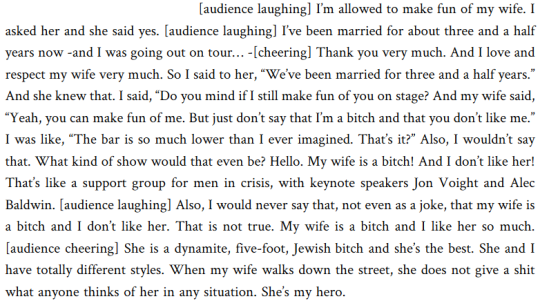
john mulaney talking about how much he loves his wife and roasting other male comedians that just talk shit on their wives is why The Gays like him so much because he’s what Straight Culture should be
he literally called her a bitch so let’s raise the standards ladies and gentlemen
the bar is at the earth’s core
literally fuck you to hell tumblr
This is the first I heard of this guy and I think this is the most dramatically I’ve seen anyone’s words taken out of context in quite a while
John Mulaney’s entire thing about his wife (and when she was his girlfriend) is about undoing the toxic horseshit that male comedians have done in talking shit about their wives for so fucking long. When he first mentions her, he says about his Jewish girlfriend “this is gonna get playfully antisemitic,” except it doesn’t [note: I am not Jewish, and I am aware that shades my perceptions]. He talks about how she’s forthright and helps him be better at standing up for himself because he’s really fucking bad at confrontation and she is very good at pointing out that he shouldn’t have to wait an hour for food at a restaurant or be stranded at an airport. The parts of her nature that would be derided for being “so Jewish” by other comedians are some of the reasons John loves her. She doesn’t take shit, and he realizes that he doesn’t have to.
When he mentions her in the latest special, he mentions the conversation quoted above before he dives in. HE IS AWARE HOW LOW THE BAR IS. And what are his stories? There’s no nagging wife. There’s no stories of her not getting how manly he is. The jokes are about what a fucking dork he is and how her responses are in line with WHAT A FUCKING DORK HE IS. He ADORES her because she doesn’t give a fuck, and he is aware he gives entirely too many fucks.
And when he finally DOES tell a story about her messing something up, it’s a hilarious misunderstanding about the Last Supper that John finds fucking hilarious because he was raised Catholic, so the Last Supper is a BIG DEAL, and she’s Jewish, so it wasn’t on her radar. The story is hilarious because it’s about a very cute and funny misunderstanding based on different backgrounds. It’s not about “finally” one-upping that bitch he married. It’s about being DELIGHTED to find out that bitch he likes so much has a fucking hilarious take on the Last Supper.
Bring me WAY MORE male comedians like John Mulaney, and this bitch will be happy.
Plus, if you compare his recent versus early shows, you can watch him come to awareness about the toxic masculinity inherent in old-school standup and grow as a comedian into someone much funnier at the same time. Kudos.
i’m back at my ancestral home (lowe’s) and I just watched a very burly man in a lot of flannel carry a potted orchid SO TENDERLY across the parking lot
A sentence that starts with “i’m back at my ancestral home (lowe’s)” has to work really hard to make the end of that sentence equally as amazing and by god you’ve done it
I didn’t realize that was an unpopular opinion! Seems reasonable to me!
I mean, I am a little out of the anime fandom loop, but of the fansubs I’ve found (there also seem to be fewer out there than there were when I first got into anime) they very much don’t do this. There was definitely a hard swing against it online for a while there–the trend admittedly went a little far at times, eg the infamous “keikaku means plan” meme–and it’s pretty hard for me to find subs, fan or official, that preserve honorifics/some Japanese words/have translator’s notes. I totally get the appeal of simpler subs that don’t include translator’s notes or what might feel like extraneous text to some people! It’s just that for me, personally…well, I might still be stuck in the early 2000s on this one.






 missionlameturtle